


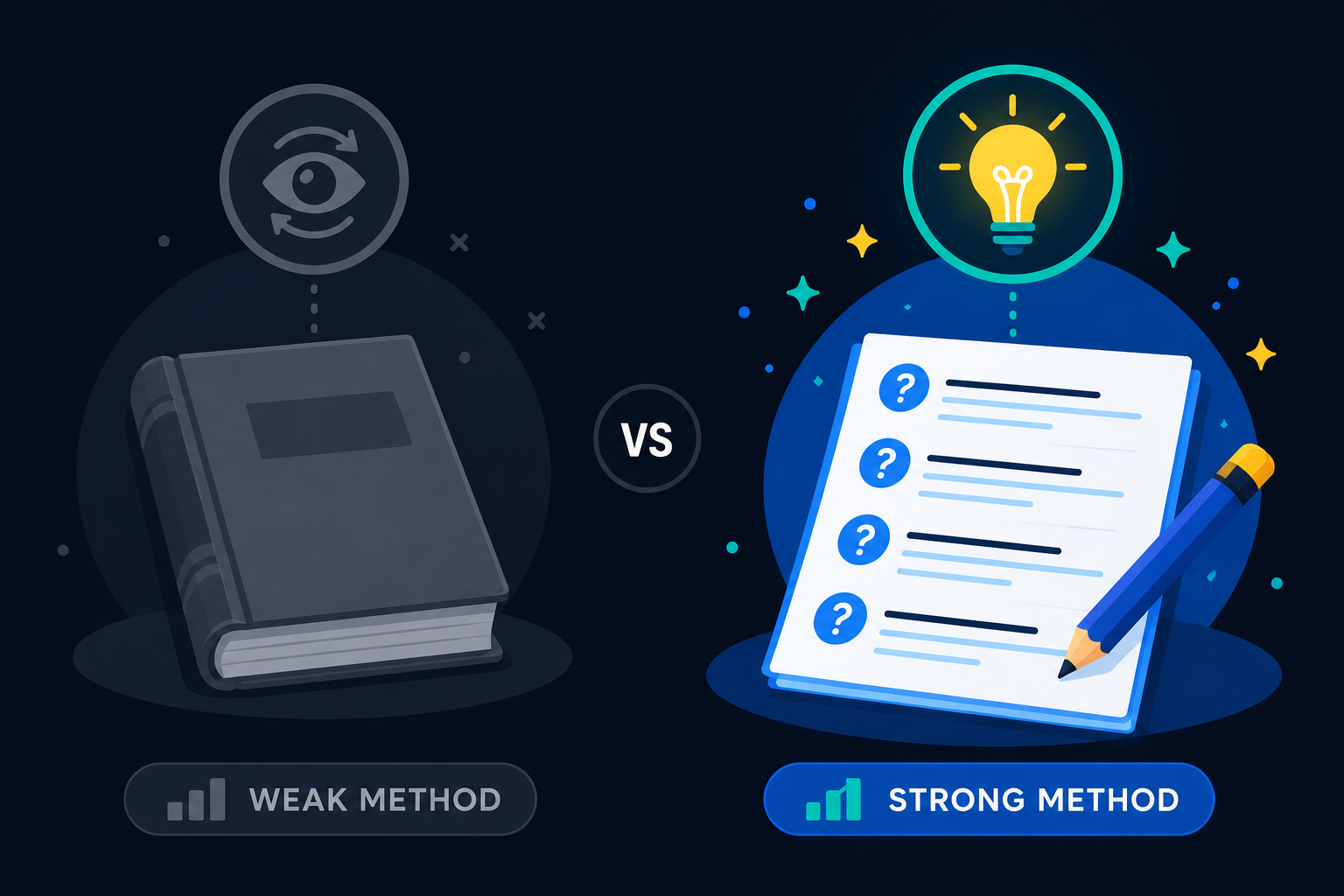
Your child reads the chapter, reads it again, closes the book, and feels ready. Then the test lands and half of it evaporates. The effort was real, so the blank feels unfair. The truth is that the problem is almost never how hard your child worked. It is the method. Re-reading feels productive while it quietly does very little, and practice tests feel uncomfortable while they quietly do almost everything.
This is one of the most reliable findings in all of learning science, and it has a name. Let me show you what practice tests actually do to memory, and exactly how to use them at home without turning study time into a stress factory.
The comfortable illusion of re-reading
When your child reads a passage for the third time, the words flow easily. That smoothness feels like understanding, but it is mostly familiarity. Psychologists call it the fluency illusion. The text is easy to read, so the brain assumes the material is known. Recognition is not recall, though. Recognizing an answer when you see it is a much weaker skill than producing it from an empty page, and an exam only ever asks for the second one.
Highlighting and recopying notes create the same trap. They keep your child inside the comfortable zone of looking at information, when the skill that actually gets graded is pulling information back out.
What practice tests do to memory
A practice test forces retrieval. Your child has to reach into memory and rebuild the answer, and that act of reaching is what strengthens the memory for next time. Researchers call this the testing effect, and it is surprisingly large.
In a now-famous experiment, memory researchers Henry Roediger and Jeffrey Karpicke had students learn material and then either restudy it or take a practice test on it. The students who restudied did slightly better on a quiz taken minutes later. But a week afterward, the students who had been tested remembered far more. The retrieval, not the rereading, is what made the knowledge last.
Taking a memory test not only assesses what one knows, it can also enhance later retention,” concluded Roediger and Karpicke after a long series of experiments. The test is not just the measurement. The test is part of the learning.
Practice tests are not the same as cramming
A practice test the night before a big exam still helps, but it helps far less than the same test spread across two weeks. Retrieval works best when a memory has been allowed to fade a little, because reaching for a fading memory is what does the real strengthening. That is why practice tests pair so naturally with spaced practice. Test, wait two or three days, then test again. Built into a steady weekly study schedule, three short retrieval sessions beat one long panicked one every single time.
How to use practice tests at home
You do not need expensive software or a stack of official past papers to begin. You only need a way to make your child produce answers from memory, and then a way to check them.
- Use what you already have. End-of-chapter questions, the teacher’s review sheet, old quizzes, and flashcards all work. Flashcards only count as practice tests when your child answers before flipping the card, not after.
- Make the book disappear. The single rule that matters most is to close the book first. Your child writes or says the answer from memory, then opens the book to check it. The struggle is the mechanism, so try not to rescue it too early.
- Always check and correct. A practice test with no feedback can teach a confident wrong answer. Mark each attempt together and note what got missed. This is also where metacognitive skills grow, because your child learns to tell the difference between “I really knew it” and “I just recognized it.”
- Keep them short and frequent. Ten minutes of retrieval, three times a week, outperforms a ninety-minute marathon. Short tests also feel less intimidating, which matters a great deal for a child who already dreads being quizzed.
If you want the results to be visible rather than vague, a tool like Smart Learn lets your child set each practice round up as a Quiz or Test event and keeps every score. Over a few weeks the trend tells you something a single grade never could, which is whether the material is genuinely sticking. That visible climb is really the testing effect drawn as a picture.
When practice tests matter most
Every subject benefits, but the payoff is largest when the stakes are high and the content is broad. Before final exams, before high-stakes standardized tests, and during any structured exam preparation stretch, practice tests are the highest value hour your child can spend.
They also build something quieter that grades tend to miss. A child who has already answered hard questions in the calm of the kitchen walks into the exam room steadier, because good test taking depends as much on familiarity with the format as it does on knowledge of the content.
FAQ
How often should my child take practice tests?
Short and frequent beats long and rare. Two or three ten-minute retrieval sessions a week, spaced a couple of days apart, is plenty for most subjects. Add one full timed run during the week before a major exam.
Will practice tests just make my child more anxious?
Low-stakes ones tend to do the opposite. When a test carries no grade and happens at the kitchen table, it stops being a threat and becomes ordinary practice. The children who panic on exam day are often the ones meeting that format for the very first time. Regular practice tests make the real thing feel familiar.
What if there are no practice questions for the subject?
Make them. Turn each heading in the notes into a question, or ask your child to write three questions a teacher might set, then answer them a day later. Writing a good question is itself an act of retrieval.
How Smart Learn keeps practice tests honest
The hardest part of retrieval practice is not the testing. It is keeping it going once the novelty wears off, and knowing whether it is actually working. Smart Learn handles both. Each practice round becomes a Quiz or Test event, every score is tracked across the term, and a simple sparkline shows the climb, so motivation comes from visible progress instead of constant nagging. Because parents and tutors see the same Smart Review, everyone knows which topics are solid and which still need another pass.
Start a free Smart Learn trial and set up your child’s first practice test as a Quiz event this week.