
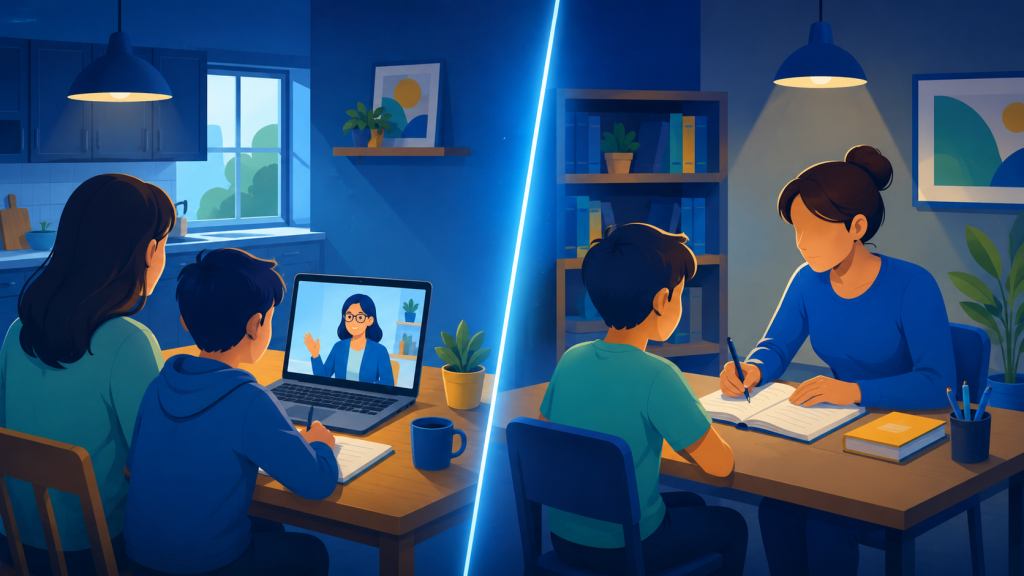

The choice between online tutoring and in-person tutoring used to be easy. You picked whoever was closest and willing to drive. That stopped being the right question around 2020. Both formats now genuinely work, and both can also genuinely fail.
This guide weighs them honestly on the four things that shape real outcomes. Convenience, focus, fit, and cost. It ends with the one factor that quietly decides which one will work for your child.
The Convenience Case for Online Tutoring
Online tutoring won the logistics fight years ago. There is no commute, no rainy Tuesday cancellation, no awkward chat about whether to offer coffee. Sessions slot into the kitchen table at 5pm and end cleanly at 6.
That convenience is not trivial. The main reason private tutoring quietly stops working is that families start canceling sessions. An online format removes the friction that drives most cancellations. A tutor in another timezone who always shows up beats a brilliant neighbor who keeps rescheduling.
Online also opens up the pool of tutors by a factor of roughly a hundred. Instead of choosing between three local algebra tutors, you can find the one whose teaching style genuinely fits your child’s learning style. For specialty subjects like AP Statistics or IB Chemistry, the local option often does not exist at all.
Cost typically lands 20 to 40 percent lower for online sessions. The tutor is not pricing in travel time. That savings adds up across a year of weekly sessions.
The Engagement Case for In-Person
In-person tutoring still has one clear edge. Parents tend to miss it before they have tried both formats. A child sitting at a table with another human being is harder to pull away from the work.
Cognitive scientist Daniel Willingham has written a lot about how attention actually works. His core point lands right on this question. Attention follows what is happening in the room. A person sitting next to your child is a far stronger signal than a person on a screen. A nine year old who would never walk away from a tutor in the room will happily click open a new tab when the tutor is on Zoom.
Memory is the residue of thought.” Daniel Willingham
What stays with a child is whatever they actively thought about during the session. In person, the social pull of another adult keeps that thinking going for the full hour. Online, the same hour can become 25 minutes of real work and 35 minutes of nodding along while half-watching YouTube in another tab.
This is not a problem for every child. Older students with solid focus can work just as deeply online as in person. But for elementary and middle school kids, the physical presence of a tutor is doing more work than the curriculum is. This is doubly true for kids who already struggle with focus.
Where the Two Formats Compare Side by Side
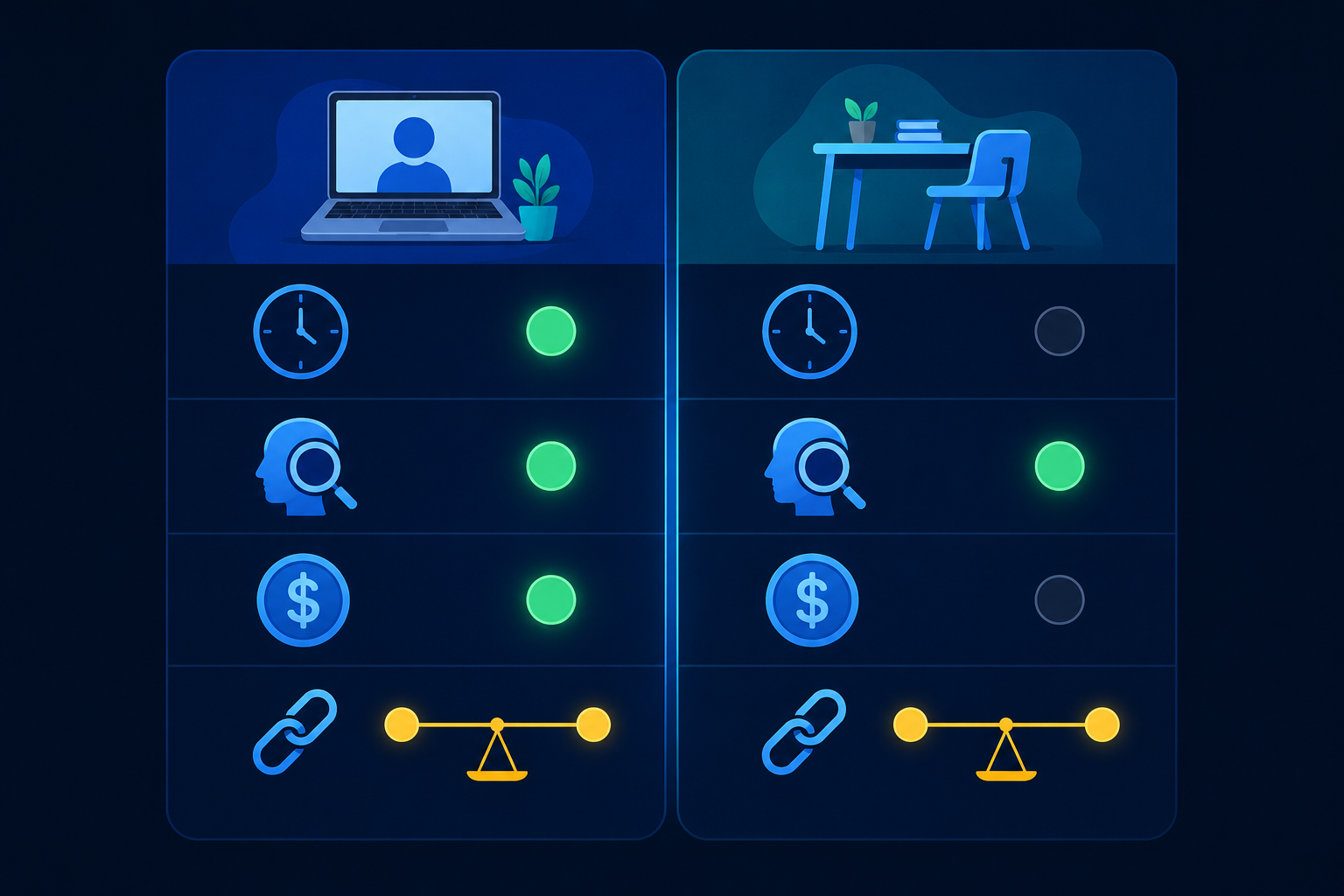
Here is how the two formats stack up on the things that actually shape outcomes.
- Scheduling and reliability. Online wins. Fewer cancellations, no weather days, no carpool conflicts.
- Tutor selection. Online wins by a wide margin. The pool is much larger, and you can match for specialty.
- Cost. Online usually wins by 20 to 40 percent per session.
- Focus and attention. In-person wins, especially for younger or distractible kids.
- Hands-on subjects. In-person wins for anything that needs physical materials. Handwriting, lab work, blocks for early math.
- Real-time read of the child. In-person edges ahead. A good tutor reads body language, and a webcam loses some of that signal.
- Parent visibility into the session. Online wins. You can overhear from the next room and pick up on tone.
- Accountability between sessions. Roughly a tie. This is what decides the whole thing, and it depends more on the tutor than on the format.
Two of these matter more than the others. Reliability and focus. Online wins clearly on the first, in-person edges ahead on the second. Everything else follows from those two.
What Actually Predicts Whether Either Works
Format is a smaller variable than most parents assume. The great tutor you choose will produce real progress in either format. A weak tutor will fail in both. The format affects how easy the tutor’s job is, but it does not change who they are.
What actually predicts progress is whether anyone has eyes on what is happening between sessions. A tutor sees your child for one hour a week. The other 167 hours are where homework gets done or does not. Where practice either sticks or fades. Where homework fights either calm down or get worse.
This is true for in-person tutoring too. It just shows up faster with online tutoring, because online sessions feel more remote. Parents are more likely to ask whether anything is actually sinking in.
When Online Tutoring Is the Right Call
Online tutoring is the right pick when:
- Your child is in middle school or older and can hold focus on a screen for 45 to 60 minutes.
- The subject is mostly text and talk. Most academic subjects, all test prep.
- You need a specialist who is not available in your area.
- Scheduling has been the thing that broke past tutoring runs.
- Budget is a real constraint.
When In-Person Still Wins
In-person tutoring is the right pick when:
- Your child is in elementary school, or in middle school but easily pulled off task.
- The subject needs physical materials. Early reading, handwriting, lab science.
- Your child has any history of checking out behind a screen.
- The tutor’s role is part academic, part focus coaching. Physical presence supports both.
These two lists are not mutually exclusive. Plenty of families run a hybrid. Most sessions online, one in-person session a month for harder topics or for trust building.
The Factor That Tips Either Way
Neither format works on its own, and that is the honest answer here. Online tutoring fails when the only thing linking the tutor to your child is a 60 minute call every Tuesday. The rest of the week becomes a black box. In-person tutoring fails the same way when nobody is watching what happens between Tuesdays.
What makes either format actually work is a visible thread of practice and feedback running through the week. The tutor needs to see what your child is doing Wednesday through Sunday. Your child needs to feel that someone notices the effort. You need to be able to ask “how is it going?” and get an answer that is not a shrug.
Smart Learn was built to be exactly that thread. It runs between sessions and captures what your child is practicing. It shows what is sticking and what is not. The tutor opens the next session with a real picture of the week. For online tutoring, this is the difference between a session that lands and one that feels like a stranger reading slides. For in-person tutoring, it is the difference between real progress and a slow drift back to the start.
Pick the format that fits your child’s age, focus, and your week. Then make sure that either way, someone is paying close attention to the other six days.